Physical interaction with the IoT: animating everyday objects

Our concept in a nutshell:

Upon hearing “The Internet of Things”, our mind day-dreams into meshes of entangled devices working around the clock, carefully sampling the environment with their tiny sensors and reporting to us at distance, in order to satisfy mankind’s voracious and inexplicable appetite for efficiency & more data. Also, many know that the Internet of Things (IoT), has become both a buzzword and a trillion dollar market — 1.9 trillion USD to be more precise. Forbes further cites an astonishing 16 billion interconnected devices by last year’s evaluations.

So two questions came to our minds: (1) where are all those “smart” devices? and; (2) why are those devices not enhancing my (human) experience?

Continue reading

The Cogs of UX

We all know the rate of change today is fierce.  As technology leaps forward, students of Human Computer Interaction may be intimidated by the breadth of topics in which they are expected to demonstrate expertise.  If one is planning an academic career, it may be possible to define a narrow area of deep knowledge.  If an industry position is desired, a broad understanding of UX (user experience) principles and the software development process may be the best preparation.

Continue reading

ACM CHI PLAY 2015: XRDS insider’s view!

 Untitled

CHI PLAY 2015 is the second edition of the ACM SIGCHI Annual Symposium on Computer-Human Interaction in Play. It is an international and interdisciplinary conference for researchers and professionals of all areas of play, games, and human-computer interaction, which fosters discussion of current high quality research in games and HCI as foundations for the future of digital play. This year the conference took place in London, UK, from the 5th to the 7th of October. Continue reading

CHI day 4 aka the end!

The last day of CHI in Seoul left everyone with that bittersweet taste of ending mixed with nostalgia and, was still a great day to see great research!

For me, the day started off with Augmented & Virtual Reality in the Real World (VR is here to stay!) and followed onto Interacting with Floors & Situated Displays (have you seen BaseLase? Check that video or the image below, quite an interesting approach to a portable large screen).

baselase

The last session of the CHI spectrum this year was Speech & Auditory Interfaces, which focused on lots of abstract sound UIs — really nice works there, go check it out if you are into sonic interaction. After this it was time for the closing keynote, by pop musician Psy. A local hero in mainstream Korea for obvious reasons and a humble speaker that decided to allude to his career build up and share lots of his personal insights with the HCI audience. At last, the next CHI was announced… see you all in San Jose for CHI’16!

Screen Shot 2015-04-25 at 3.04.20 AM

CHI Day 3

Disclaimer: CHI is a multiple track conference, with a dozen of parallel sessions, so the truth is: I’ve never felt a bigger desire for ubiquity (the great thing is that this year things are being recorded and will be on the ACM Digital Library soon. Thanks to the SVs for filming the talks!)

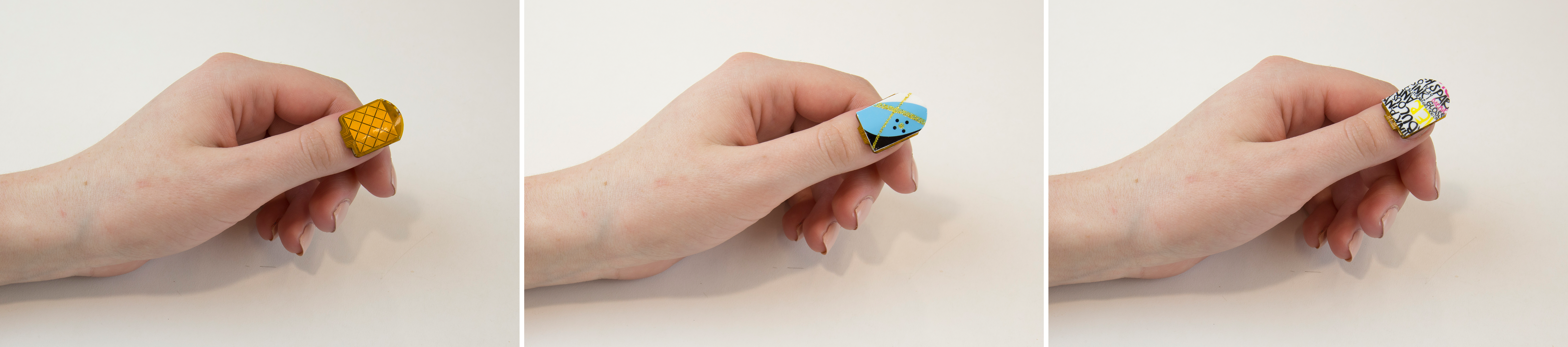
In the third day of CHI a lot of attention was given to future interfaces that attach directly to the users’ body. The great thing is that being a research conference, CHI goes much further than the wearables and smartwatch industry so researches here presented developments in haptic wearables that control your muscles (an example of that is my own work presented this year), rings that notify you using temperature (Notiring), interactive tattoo-like stickers that allow you to interact directly onto your skin (iSkin), and even nail covers that allow you to secretly interact with your technology (NailO)!

Some future interfaces that live on your body: a bracelet that reads and writes to your muscles and a Nail interface:
Proprioceptive Interaction
NailO

Of course the CHI community is not only about new hardware but a much broader and grounded on the understanding of Computing and Human Factors. This means over the past three days we’ve seen many explorations and studies that provide a deeper understanding of the world of ergonomics, crowd-sourcing, collaborative work, interaction techniques, and human cognition too.

Furthermore, this year there has been an amazing body of work that takes the CHI community to the real world as discusses important, real-world questions, such as “Encouraging Energy Conservation”, “Gender inclusive Software” and a great focus (as always) in making HCI (and CHI) accessible to all people!